Arts, Crafts and Traditions
ÉMILIE-GAMELIN PARK, BERRI-UQAM METRO
JUNE 15, 16 AND 17
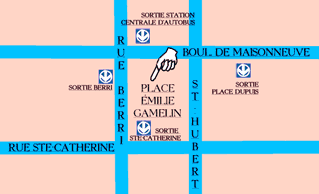
In the heart of Montreal, Émilie-Gamelin Park is becoming a focus of fervent exchanges, a safe harbour and a creative space. An authentic universe will take shape there, hitherto-unknown worlds appearing at twists and turns of symbolic trails branching out into many paths to discovery and renewal.
Against the ravages of shortsighted development, the persistence of ancestral technology, safeguarded by men and women who are very much our contemporaries, is a dynamic heritage whose teachings, from generation to generation, are part and parcel of a cultural and spiritual affirmation proudly raising its head against steamroller modernity.
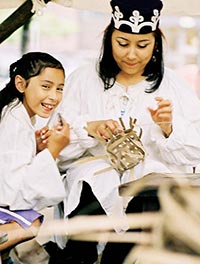
Before our eyes, more than forty artists and craftspeople make objects, tools, jewellery, clothing and utensils that define their relationship to the land and their efforts to communicate this deep sense of belonging to a place and culture that developed there. Weaving, beading, tanning hides, sculpture, painting and basketry are all forms of resistance to the erosion of identity.
Over the years, the First Peoples' Festival outdoor site has become an essential witness to the many facets of First Nations cultural and spiritual universes.
To Learn More
Many dynamic First Nations organizations taking the lead in tourism and cultural development, museums and service firms will be on hand in a section of the site, providing visitors an opportunity to learn about aspects of First Nations reality that will certainly contribute to their experience and encourage them to explore further.

The Borucas, Ancestral Memory of Costa Rica
ÉMILIE-GAMELIN PARK, BERRI-UQAM METRO
JUNE 15, 16 AND 17
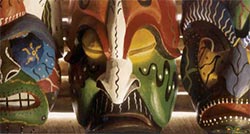
The Borucas (or Brunkas) are one of the 24 Aboriginal peoples of Costa Rica. They live in the mountains of the southern Pacific region of Costa Rica, in two major communities.
Recent genetic, linguistic and ethnographic studies prove that they have a clear filiation with the Chibcha people in northern South America, who range from Central America (Costa Rica) down to Cape Guayaquil, on the border between Ecuador and Peru.
For some years now, their language has been part of the mandatory school curriculum and many young people are very proud to be able to speak it.
The Borucas have preserved their traditional crafts, above all weaving cotton dyed with natural pigments, sculpting cedar wood masks in natural tones or polychrome, painting masks on balsa wood, using calebasse gourds to make vessels, still in use to brew chicha (an alcoholic beverage fermented from corn), as well as to make drums, bows and arrows.
Marina Lazaro, a weaver, Margarita Lazaro, a weaver and storyteller and José Gonzalez, a mask maker, will be on hand to demonstrate their crafts, displaying the variety and resources of a culture that has succeeded in safeguarding its identity.
Initiation to Archaeology
ÉMILIE-GAMELIN PARK, BERRI-UQAM METRO
JUNE 15, 16 AND 17 NOON TO 5 P.M.
RECHERCHES AMÉRINDIENNES AU QUÉBEC
Before the astonished gazes of their audience, archaeologists Martin Lominy, Yves Chrétien and Michel Cadieux recreate everyday objects, weapons, tools, jewellery and containers used by pre-contact First Nations. They will bring archaic techniques forgotten for centuries back to life: these masters of the past are old hands at stonecutting, methods of lighting fires, net making and prehistoric pottery.
These archaeologists are guided by a firm conviction that the findings of archaeological digs must be made accessible to a broader public. They are committed to bringing the first men and women who walked upon this continent back to life. In their hands, archaeology becomes an excellent means of providing popular scientific education. For these three archaeologists, expertise does not rule out a sense of humour.
Martin Lominy is an independent researcher and artisan in experimental archaeology, working as a facilitator at McCord Museum. He has spearheaded educational programs, cultural activities, research and presentations for museums, interpretive centres and presenter organisations. His presentations looking at how ancient people fished will include tips on making a fish line, more precisely the line itself and the hook, as well as techniques for weaving fishing nets.
Yves Chrétien's discovery at Cap Rouge provided evidence of Roberval and Cartier's settlement at this location between 1541 and 1543. This key site will be accessible to the public in 2008 for the commemoration of Québec City's 400th anniversary. Chrétien's exploit has not made him give up doing presentations. He can light a fire of twigs in a single minute thanks to his mastery of prehistoric technology. He will give a striking demonstration of this skill when he comes to Émilie-Gamelin Park. With the more sophisticated firebow method of the St. Lawrence Valley nations, he can light a fire in forty-five seconds! Sparking our curiosity!
Over the years, Michel Cadieux has developed an expertise in prehistoric technology and an unequalled talent as a communicator. He is an old hand at stonecutting, and working ceramics, bones and antlers as well as native copper. In a short time, he fashions points, drills, axes, scrapers, knives and other tools before the eyes of the spectators who always crowd around the ancient workshop that he brings back to life.
The presentation and information booth at the Drouler archaeological site's Interpretive and a display on the journal and books published by Recherches amérindiennes du Québec round out the archaeological segment of the First Peoples' Festival.
Geronimo, Shanipiap and their Friends
A Friday afternoon dedicated to fantasy and laughter.
JUNE 15 FROM NOON TO 5 P.M.

GERONIMO STILTON
Geronimo Stilton, the famous editor of L'Écho du rongeur, always on the lookout for book ideas, will be on hand to welcome his many readers. What fantastic adventure will he concoct next? A single encounter with this scholarly rat will reveal the ingredients of fabulous worlds. Witches, dragons, elves and giants will certainly join in the adventure.
In "Les découvertes de Shanipiap" (Shanipiap's discoveries), storyteller, poet and musician Geneviève McKenzie, whose Innu name is Shanipiap, takes us on an initiatory journey to contemporary First Nations. "We have to learn what we were to better become what we are now". Her smile and voice are familiar to more and more young Aboriginal people. We extend an invitation to meet her at the APTN stand, spotlighting Canada's Aboriginal Television Network.
Mikuan (Dina Bacon) and Ushkui, the birch tree (Waubnasse Simon) from the youth series Mikuan et Ashini from Productions K8e K8e will also join in the party.
A workshop on making cornhusk masks facilitated by author and actress Sylvie-Anne Sioui-Trudel will round out our first youth activities day.
Powwow Great Drum
Symbolism and role
ÉMILIE-GAMELIN PARK, BERRI-UQAM METRO FRIDAY
JUNE 15 AT 1 PM
WITH CHAD DIABO
CHAD DIABO
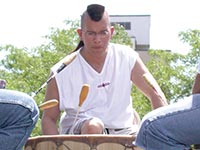
Chad Diabo is a Mohawk from Kahnawake. He works with Aboriginals from all nations in Quebec at the Montreal Native Friendship Centre. We have the opportunity to meet a young man with a huge heart and a great deal of pride who keeps his tradition alive in an urban setting. He is in the midst of the upheavals most First Nations youth who are leaving their communities experience. Chad Diabo is very proud of his roots and involved in a range of activities to improve the quality of life and daily lives of his fellow Aboriginals. He will help us discover Mohawk soul, values and spirituality.
He is the drum carrier with the Tiohtiake group with young people from Montreal Native Friendship Centre. He will be sharing his knowledge of powwow song and drum with the Montréal First Peoples' Festival public.
Boréades — Dance Event
ÉMILIE-GAMELIN PARK, BERRI-UQAM METRO
FRIDAY SATURDAY AND SUNDAY JUNE 16 AND 17, 2 P.M. - 6 P.M.
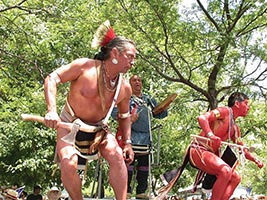
Dance is memory and celebration. The dancers' steps and finery echo the sights and sounds of life. Troupes from many traditions and horizons come dressed in their finest regalia. The drums announce the gathering storm or the hunting season. The stage is set for romance, births and harvests. Ritual or celebratory dance can conjure up the spirit world or the rhythms of daily life, marking the seasons of the First Peoples.
Under the Chad Diabo's guidance, Montreal Native Friendship Centre's powwow drum and dance group Tiohtiake gives the starting signal.
Dancers from Mohawk, Wendat, Abenaki, Quechua and Boruca traditions display an age-old know-how interpreted with the verve and creativity of youth, at the festival's outdoor site.
THE FEAST OF THE DEVILS
Ancestral memories come alive with the Feast of the Diabolitos (or cagrú_rojc in the Brunca language) which took place at Boruca, from December 30th to January 2nd and at Rey Curré at the second moon of the year, in February. This celebration features dances and games recalling the encounter between the Spaniards and the Borucas at the time of the conquest. The participants adorn their faces with multicoloured devil masks decorated with horns and feathers ; they wear costumes made of jute fabric (gangoche) or large banana leaves. More recently, traditional weaving has also become part of the festive regalia.
For three days and three nights, they symbolically reenact the struggle against the Spanish conquistators, played by a participant disguised as a bull. They travel round the village several times. In each house, they are greeted with tamales (rice cooked with smoked pork, cooked in bijagua leaves ‹Calathea-discolor‹) and chicha.
The festival has two moments of climax: at first, the bull succeeds in defeating the Borucas, after that, the mythical hero Cuásran brings them back to life and gives them the courage to overcome the bull, who will finally be burnt on the village square. Its flesh is allegorically divided among all the inhabitants. The Borucas always emerge as the victors, although they may seem vanquished. The festival concludes with a bonfire and dance that lasts all night long. Les Boréades de la danse is welcoming the Borucas. The dances of the Diabolitos feast are a celebration of resiliance and openness. An ideal means of winning the day, against the conquistadors' mighty bull.
QUABBIN LAKE SINGERS AND DANCERS
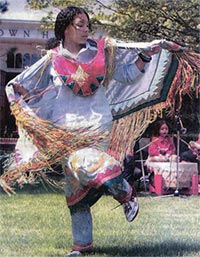
For the very first time at the Boréades de la danse, the Quabbin Lake Singers and Dancers, a troupe of a dozen-some members of the Nipmuc nation (Nipamaug) whose name means "the people from the place where we fish in sweet water". The Nipmucs are a small group with various Aboriginal origins and a little-known history, from New England.
Like the majority of First Nations in North America, the Nipmucs have joined in the great powwow movement that originated on the Western plains. They offer their version of the powwow style dance repertory to the rhythms of the Great Drum.
The Quabbin Lake Singers and Dancers are also proud to have the youngest drum singer on the powwow circuit. This young man with a powerful voice is only 11 years old he started performing at the age of four and has presented his repertory of traditional Nipmuc songs during several events in Canada and the United States, with the ensemble and as a solo performer.
JIG ON THE FLY
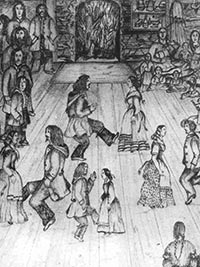
Like Métis music, Métis dance draws upon elements from the Scots, Irish, French and First Nations. Although these dances incorporate a large variety of steps and movements, three main steps are front and centre and clearly position these dances within the Métis nation's cultural universe. The dancers' typical footwork remains quite literally down to earth, close to the dancefloor.
The rabbit dance depicts an excited dog chasing a rabbit. The woman pretends to flee but her partner catches up with her quickly.
The Red River jig is known for driving Métis dancers mad: just nailed to the floor the dancer's moccasins while this frenetic jig is played and the dancers goes crazy. Every good dance soirée has its moments of madness.
SCHEDULE
| SATURDAY JUNE 16 | |
| 2:00 p.m. | TIOHTIAKE |
| 2:30 p.m. | KEEPERS OF THE EASTERN DOOR |
| 3:00 p.m. | QUABBIN LAKE SINGERS |
| 3:30 p.m. | KEEPERS OF THE EASTERN DOOR (RED TAIL SINGERS) |
| 4:00 p.m. | QUABBIN LAKE SINGERS |
| 4:30 p.m. | ALN8BAK |
| 5:00 p.m. | ODAWA NATIVE FRIENDSHIP CENTRE |
| 5:30 p.m. | JIG ON THE FLY |
| 6:00 p.m. | ATIKUSSET |
| 6:30 p.m. | BORUCAS |
| 7:00 p.m. | TIOHTIAKE |
| SUNDAY JUNE 17 | |
| 2:00 p.m. | TIOHTIAKE |
| 2:30 p.m. | KEEPERS OF THE EASTERN DOOR (RED TAIL SINGERS) |
| 3:00 p.m. | QUABBIN LAKE SINGERS |
| 3:30 p.m. | KEEPERS OF THE EASTERN DOOR |
| 4:00 p.m. | KOLASUYO |
| 4:30 p.m. | ANDICHA N'DE WENDAT |
| 5:00 p.m. | ODAWA NATIVE FRIENDSHIP CENTRE |
| 5:30 p.m. | AWASSISAK AKIK |
| 6:00 p.m. | ATIKUSSET |
| 6:30 p.m. | TIOHTIAKE |
IN THE EVENT OF RAIN :
the dance troupes will perform at the Agora of UQAM'S Judith-Jasmin building, 405 St. Catherine St. E.
Igloo lounge

MADESKIMO

VAINVARD
ÉMILIE-GAMELIN PARK, BERRI-UQAM METRO
JUNE 16, 9 P.M.
SOCIETY FOR ARTS AND TECHNOLOGY [SAT]
1195, Saint-Laurent Blvd.
JUNE 21, 10:45 P.M.
An « ethno groovy » musical encounter between an Inuit D.J. from Iqaluit, a traditional throat singer from Nunavik and a Montrealer. Urban rhythms mixed with sounds of the north and Katajaks (throat singing). Visually, it's just a wink at some "clichés" of the arctic world.
Geronimo Madeskimo : He opened the first corn popping evening of the 2006 first people's festival at S.A.T.
Vainvard : During the 90' in New-York, he in many things sang backups for Joey Arias. He presented a solo vocal performance at "Les Nuits Atypiques" of Langon (FR.) in 2002. Sylvain Rivard also know has Vainvard sang the D.J. Mr. Smith at Divers/cité 2006 Sunset Party. He co-wrote "Archéologie Sonore Chants amérindiens" published in 2001 (Éditions 3). You can also hear him on the youth disk/book "Le tour du monde en chansons" (Fides 2003 ) and many documentaries and television projects.
Akinisie : She gave performances of her Katajaks (throat songs) during many events in Europe and America.
Inuit Sivuniksangat
AUDIO : MADESKIMO
Mumiqsiuti